Syd Field, Screenwriting, and Three-Act Structure

Only the immature artist scoffs at the demands of form. “Free verse,” quipped Robert Frost, is like “playing tennis without a net.” There is a reason why the films of Terence Malick, as brilliantly associative as they are, tax our patience.

Syd Field died on the 17th of this month. He was, along with Robert McKee, one of Hollywood’s most influential “gurus” on the art of screenwriting. Untold numbers of writers have learned from him, among them Tina Fey: “I did a million drafts. And then I did the thing everybody does–I read Syd Field and I used my index cards.”

Syd Field wrote many books on screenwriting, but he is best known for Screenplay, first published in 1979 and revised several times since. In Screenplay Field clarifies the basic three-act structure of the modern film–and indeed, of all narrative art. Field did not invent this structure; we find Aristotle beginning to rough it out in his Poetics. But just as Watson and Crick did not invent DNA, but made known its structure, so Field, while not inventing story structure, made it eminently manifest to a contemporary audience.

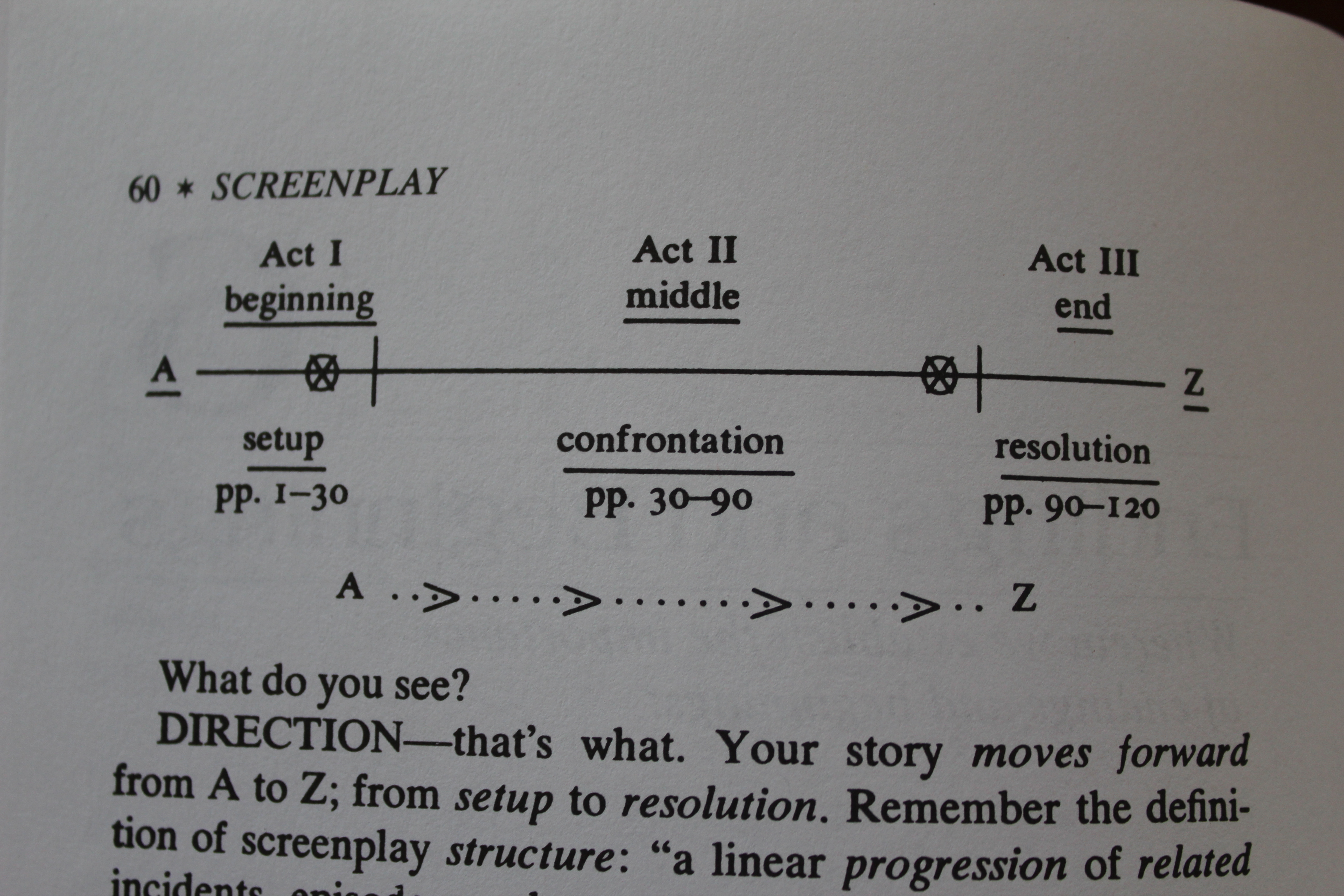
Act I. An inciting incident upsets the hero’s plans and he is thrown into an adventure. Act II. The attempt to bring the adventure to a halt only results in further complication. Act III. The hero faces the ultimate obstacle to the resolution of his difficulty–an obstacle he either succeeds at overcoming, or fails.

Setup. Confrontation. Resolution.

That’s what a story is.

Field was particularly insistent upon writers knowing the ending of their story: “What is the ending of your story? How is it resolved? Does your main character live or die? Get married or divorced? Get away with the holdup, or get caught? Stay on his feet after 15 rounds with Apollo Creed, or not? What is the ending of your screenplay?” Field believed that the ending is the first thing a writer should know before writing his or her story.

Sound formulaic? Is Field only giving us a recipe for the conventional film with the “Hollywood ending”?

Consider, then, a more highbrow authority, Gilbert Murray (1886-1957), Regius Professor of Greek at Oxford, among other posts. “Most contemporary plays,” writes Murray in The Classical Tradition in Poetry, “admirable in detail and stagecraft as they often are, have weak last acts. Similarly, in the novel…you find a number of writers who can give exquisite studies of character, delicious conversations and individual scenes, but very few who can construct a story with a definite unity of effect and proper climax, or, to use the Greek term, “catastrophe.” One might almost say that they leave that high quality to the writers of detective stories.”

Listen to Professor Murray. The “definite unity of effect and proper climax” is today found most prominently in works of detective and other genre fiction, as well as, we might add, at the movies. Artistes may scoff at three-act structure as the slop of the “masses,” but Murray, notice, refers to it as “that high quality.” It is not a mistake, or in itself a sign of steep cultural decline, that scores of people will flock to their local multiplex this Thanksgiving weekend, rather than hunker down by the fire with Ulysses.

The central reason why three-act structure resonates so profoundly with the human spirit, such that we never tire of its rhythms, is that it allows us, in a most compressed and evident way, to contemplate our lives in miniature. Three-act structure is the structure of life. It is the imitation of ourselves being thrown into an adventure not of our choosing, and of working out a resolution to it in which we ultimately either succeed or fail. Field rightly lays emphasis upon the ending of a screenplay because the whole point of our lives is the ending. Will I realize who I was made to be, or not?

In his work Field gave storytellers not a recipe, but a set of principles applicable in an infinite variety of creative ways, ways as various as the adventures of individual human lives.

Thank you, Syd Field, for your life and work. May you rest in peace.


This article first appeared on Aleteia.
 

Writing High Comedy in an Age of Irony

This is Part 1 of a talk I gave last week (November 20, 2013), to the Annapolis Chapter of the Maryland Writer’s Association. What a delightful evening I had with this group!

Metaphor and the Desire to Know

As obliterating fire lights up a vast forest

along the crests of a mountain, and the flare shows far off,

so as they marched, from the magnificent bronze the gleam went

dazzling all about through the upper air to the heaven.

Homer, Iliad, Book II, lines 455-458 (translation Lattimore)

It is older even than the craft of written story: the desire to compare this to that; to illuminate the perception of one thing by juxtaposing it to some other. This is metaphor, a word derived from a Greek word which literally means “a bearing across” or a “transfer.” My father once saw in Athens a moving van with the company title painted across it: METAPHORA.

One Thing and Another

To understand how transference works in literary terms, consider the passage from Homer in my epigraph. The Achaian army is on the move. The poet wants us to clearly perceive how the dazzling gleam from their bronze armor lights up the sky, so he borrows a perception from elsewhere: a forest fire lighting up the (presumably) night sky along the crest of a mountain. In technical grammatical terms this is a simile (as the poet says “As obliterating fire….”), but we won’t fuss over that distinction. The more intriguing question is, why does the poet bother about “transferring” the image of the forest fire to the image of the marching army? We can imagine a lesser poet describing the marching army by using only the last two lines from the quoted passage:

so as they marched, from the magnificent bronze the gleam went/dazzling all about through the upper air to the heaven.

But the effect in this case would be diminished. The “transference” of the forest fire image helps make vivid the gleam from the bronze armor. It is not so much, perhaps, that the forest fire image is in itself more vivid than the image of the bronze gleam from the armor. After all, can’t we imagine a poet describing the flare of a forest fire along a mountain crest by comparing it to the gleam from the bronze armor of a marching army? At one level, it seems it is the juxtaposition, or collection, of images that vivifies the image of the marching army. The more perceptions there are, the more intense our literary delight. But not just any perceptions will do. Among the images there needs to be likeness in the midst of unlikeness. For the metaphor to work, the flare in the mountains must be like the gleam of the bronze.

The Attraction of Metaphor

In his esteemed work of literary criticism, the Poetics, the Greek philosopher Aristotle asserts that of all the modes of literary expression metaphor is the greatest. He even goes on to contend that he doesn’t think the craft of making metaphors can be taught; it is a mark of genius. Whatever we may think about that, Aristotle concludes his tribute to metaphor by saying that in making good metaphors one is “contemplating” the likenesses of things.

Here is the attraction of metaphor: we love to contemplate the likenesses of things in the midst of their unlikeness. But why? Because in perceiving likeness amidst unlikeness, we deepen our knowledge of the world.

In Homer’s metaphor, the knowledge we gain is mainly perceptual. We understand better the visual effect of the bronze armor’s gleam by comparing it to a forest fire. But the comparison of the armor’s gleam to the fire’s flare also brings with it a sense of awe. For only a vast and terrible army could produce that kind of gleam from its armor, just as only a vast and terrible forest fire could light up the night sky above a mountain.

All human beings desire to know, Aristotle says in another famous text. And we come to know reality, he continues, first of all by making comparisons through our senses, comparisons which ultimately inspire the mind to make deeper distinctions between things. To make a distinction is to discern how one thing is both like and unlike another, a discernment which helps reveal what is essential to each.

So the making of metaphor, in which we ponder likeness amidst unlikeness, is one way in which we express our desire to know; and if Aristotle is right that it is the most important mode of literary expression, then it seems that writers must attend to the making of metaphors.

Learning from The Master

Enough, however, of these minor thinkers. Let’s turn finally to a classical source: the work of the humorist P.G. Wodehouse. Evelyn Waugh, who bowed to no one in his admiration of Wodehouse’s craftsmanship, once praised Wodehouse for being able to produce two to three striking similes or metaphors per page. Such as:

The butler loomed in the doorway like a dignified cloudbank.

Here the obvious unlikeness between butler and cloudbank opens up an enormous gap. But the brilliance of the simile is found in the fact that in a certain skewed, over-the-top perception, there is a sense that a beefy butler looming quietly in a doorway is like a cloudbank. Just as a man’s dancing style can resemble a man giving alms:

“Can you dance?” said the girl.

Lancelot gave a short, amused laugh. He was a man who never let his left hip know what his right hip was doing.

Metaphor, however, whether serious or humorous, is not restricted to local description and color. It can also work for larger thematic purposes. In Hemingway’s The Sun Also Rises, bullfighting serves as a metaphor for grace under pressure. T.S. Eliot’s image of “waste land” serves as a metaphor for moral and spiritual decay. Metaphor is in fact the key to all imaginative writing. Indeed all thought and language, if Iris Murdoch is correct, is metaphor. “The development of consciousness in human beings,” Murdoch affirms, “is inseparably connected with the use of metaphor. Metaphors are not merely peripheral decorations or even useful models, they are fundamental forms of our awareness of our condition.”


* The image at the top of this post is of the 4th-century Greek philosopher Aristotle.