Syd Field, Screenwriting, and Three-Act Structure

Only the immature artist scoffs at the demands of form. “Free verse,” quipped Robert Frost, is like “playing tennis without a net.” There is a reason why the films of Terence Malick, as brilliantly associative as they are, tax our patience.

Syd Field died on the 17th of this month. He was, along with Robert McKee, one of Hollywood’s most influential “gurus” on the art of screenwriting. Untold numbers of writers have learned from him, among them Tina Fey: “I did a million drafts. And then I did the thing everybody does–I read Syd Field and I used my index cards.”

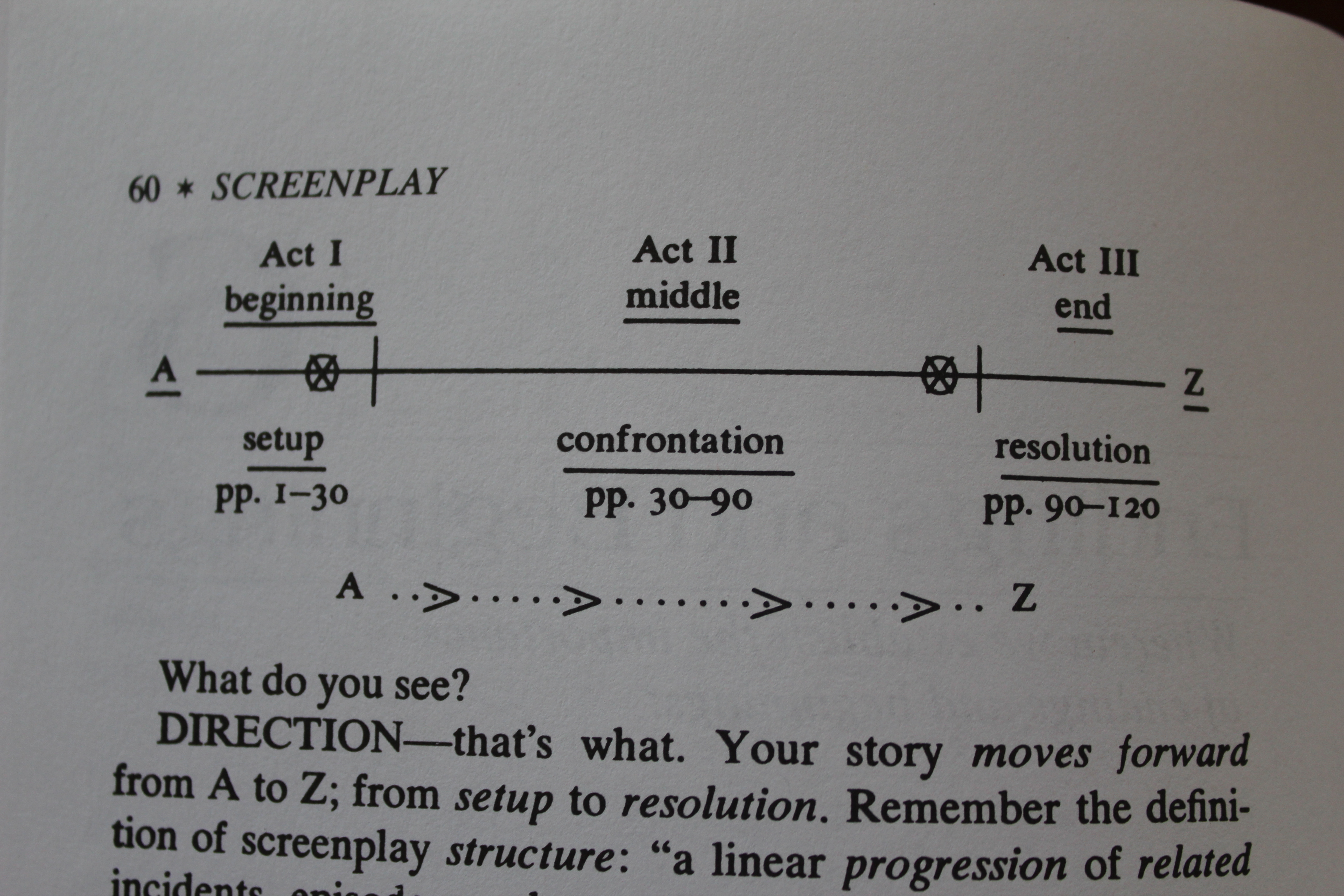
Syd Field wrote many books on screenwriting, but he is best known for Screenplay, first published in 1979 and revised several times since. In Screenplay Field clarifies the basic three-act structure of the modern film–and indeed, of all narrative art. Field did not invent this structure; we find Aristotle beginning to rough it out in his Poetics. But just as Watson and Crick did not invent DNA, but made known its structure, so Field, while not inventing story structure, made it eminently manifest to a contemporary audience.

Act I. An inciting incident upsets the hero’s plans and he is thrown into an adventure. Act II. The attempt to bring the adventure to a halt only results in further complication. Act III. The hero faces the ultimate obstacle to the resolution of his difficulty–an obstacle he either succeeds at overcoming, or fails.

Setup. Confrontation. Resolution.

That’s what a story is.

Field was particularly insistent upon writers knowing the ending of their story: “What is the ending of your story? How is it resolved? Does your main character live or die? Get married or divorced? Get away with the holdup, or get caught? Stay on his feet after 15 rounds with Apollo Creed, or not? What is the ending of your screenplay?” Field believed that the ending is the first thing a writer should know before writing his or her story.

Sound formulaic? Is Field only giving us a recipe for the conventional film with the “Hollywood ending”?

Consider, then, a more highbrow authority, Gilbert Murray (1886-1957), Regius Professor of Greek at Oxford, among other posts. “Most contemporary plays,” writes Murray in The Classical Tradition in Poetry, “admirable in detail and stagecraft as they often are, have weak last acts. Similarly, in the novel…you find a number of writers who can give exquisite studies of character, delicious conversations and individual scenes, but very few who can construct a story with a definite unity of effect and proper climax, or, to use the Greek term, “catastrophe.” One might almost say that they leave that high quality to the writers of detective stories.”

Listen to Professor Murray. The “definite unity of effect and proper climax” is today found most prominently in works of detective and other genre fiction, as well as, we might add, at the movies. Artistes may scoff at three-act structure as the slop of the “masses,” but Murray, notice, refers to it as “that high quality.” It is not a mistake, or in itself a sign of steep cultural decline, that scores of people will flock to their local multiplex this Thanksgiving weekend, rather than hunker down by the fire with Ulysses.

The central reason why three-act structure resonates so profoundly with the human spirit, such that we never tire of its rhythms, is that it allows us, in a most compressed and evident way, to contemplate our lives in miniature. Three-act structure is the structure of life. It is the imitation of ourselves being thrown into an adventure not of our choosing, and of working out a resolution to it in which we ultimately either succeed or fail. Field rightly lays emphasis upon the ending of a screenplay because the whole point of our lives is the ending. Will I realize who I was made to be, or not?

In his work Field gave storytellers not a recipe, but a set of principles applicable in an infinite variety of creative ways, ways as various as the adventures of individual human lives.

Thank you, Syd Field, for your life and work. May you rest in peace.


This article first appeared on Aleteia.

 

Writing High Comedy in an Age of Irony

This is Part 1 of a talk I gave last week (November 20, 2013), to the Annapolis Chapter of the Maryland Writer’s Association. What a delightful evening I had with this group!

Character Wants and Character Needs

Create memorable characters for your stories with the help of the distinction between character wants and internal character needs. Our discussion on today’s The Comic Muse Podcast.

In this podcast you will learn about

  • the most basic question a writer needs to answer in order to develop a compelling character
  • why what a character wants is not always exactly what a character needs
  • how a character’s internal need is connected to your story’s Controlling Idea

Works discussed in this podcast:

  1. Flannery O’Connor’s essay “Writing Short Stories” in her collection of essays, Mystery and Manners.
  2. David Corbett’s The Art of Character.

Character Wants and Character Needs 3


Action is Character

Celebrated crime author David Corbett has a wonderful post over on Joanna Penn’s blog about writing character and especially how character is revealed by action. Check it out. It’s one of the best pieces on character I’ve seen.

I’ll leave it to you to enjoy Corbett’s entire post, but I’ll at least set out for you the five principles that Corbett outlines–emphasizing that they are principles, meaning guidelines that can be applied in myriad ways, not paint-by-number instructions.

First, character is revealed by someone’s need or want. Someone has to be in motion toward some good he wants to get, or evil he wants to avoid, even if it‘s only Bertie Wooster lying in bed wishing he didn’t have to lunch with his Aunt Agatha.

Second, character is revealed when someone, usually after formulating an imperfect plan for achieving his want, runs into difficulty. Obstacles. Conflict. We wouldn’t have a story or a character if Coraline in Neil Gaiman’s eponymous fable didn’t find herself trapped with her “other” mother.

Third, character is revealed when someone exhibits a (seeming) contradiction. As when Flannery O’Connor’s protagonist Hazel Motes in Wise Blood cannot get rid of the thought of Christ no matter how hard he tries to dispel it.

Fourth, character is revealed when something unexpected happens, when the character makes a mistake that renders him vulnerable. Think about when David realizes he married the wrong woman in Dickens’ David Copperfield.

Finally, character is revealed when we realize that there’s more to the character’s predicament than meets the eye. When it’s clear that the character has a secret. As when in The Great Gatsby Nick Carraway goes to lunch with Gatsby and discovers that he associates with gangsters.

What I find marvelous about these principles is the way in which character is revealed more by action–pursuing some want, running into obstacles, trying to overcome them– than by soul-searching. This doesn’t mean that the interior monologue prevalent in so much literary fiction, not to mention in Shakespeare, is unacceptable; it means that even the interior monologue must focus on real patterns of the character’s action, and not just the articulation of emotion, if it is going to succeed.

I also liked how Corbett argues that the reasons why these principles are so important is because they go to the heart of who we are as human beings. Human beings, after all, are characters in stories.

Because I write fiction so much in the comic mode, it’s also interesting for me to think about how these principles are applicable to writing comic characters. I hinted at one such application in mentioning P.G. Wodehouse’s Bertie Wooster. But each of us will have to work to find out how these principles are applicable to the characters we are trying to depict.

Please share with us whatever triumphs, or problems, you experience in this endeavor.


P.S. Corbett has a new book out on this topic: The Art of Character. I for one am looking forward to reading it.

Ideas and Stories

 ”Storytelling is the creative demonstration of truth. A story is the living proof of an idea, the conversion of an idea to action.”  –Robert McKee, Story

In this edition of The Comic Muse Podcast we talk about the “soul” of story or what Robert McKee calls the Controlling Idea.

In this podcast you will learn about

  • the supreme importance of a strong, clear idea to the success of your story
  • the basic equation of a good story idea: VALUE + CAUSE
  • the necessity of integrating your idea into the “body” of your story

Books discussed in this podcast:

  1. Robert McKee, Story
  2. David Lodge, The Art of Fiction
  3. Flannery O’Connor, Mystery and Manners
  4. Anthony Burgess, A Clockwork Orange
  5. F. Scott Fitzgerald, The Great Gatsby


Ideas and Stories

“Don’t Call an Ambulance. It’s Only an Artistic Coma!”

I love reading biographies of authors. I love reading most about the period of their early struggle (and, frankly, I often lose interest after the author achieves success). Just last night I dipped back into the early chapters of Robert McCrum’s magnificent Wodehouse: A Life.

“The quality of [Wodehouse’s] life as a freelancer was solitary and unremitting. He hardly ever went out. He was working too hard. After the Globe in the morning, he would walk back to his lodgings and start work right away. Occasionally, he would break off to play cricket, but he was too keen on his work to leave his desk for long.” McCrum, p. 57

Wodehouse, author of over one hundred books, was clearly a writer who knew how to induce what Dorothea Brande calls the “artistic coma.”

Artistic coma? Sounds dangerous. What is it?

The artistic coma is more commonly referred to today as the “zone,” or “flow,” or being “in the groove.” It’s that state of being lost in the imagination but in such a way that one doesn’t just stare at the wall, but rather, almost without effort, writes.

Inducing the artistic coma, as Brande teaches in Becoming a Writer, is really a simple process. Almost silly it’s so simple. First we have to learn to quiet the mind. Which is why constant checking of email and social networks during a writing stint is a terrible habit. Believe me, I know. To quiet the mind means to still the “chattering monkey” of our thoughts, and for that the even louder chattering monkey of the Internet needs to be, for a time, locked in its cage.

But the artistic coma is not just a matter of quieting the mind. Once a habit of quiet has been cultivated, then a story idea or character can be brought in. In the womb of relaxed silence the idea gestates.

And then?

“Presently you will see the almost incredible results. Ideas which you held rather academically and unconvincingly will take on color and form; a character that was a puppet will move and breathe. Consciously or unconsciously every successful writer who ever lived calls on this faculty to put the breath of life into his creations.” Brande, p. 166

All that pencil sharpening that writers do? All those games of Internet solitaire? All that leisurely strolling and paper clip sculpting? It’s all done, wittingly or no, to put the mind in a state of languidly alert stasis, a “coma” not unlike the moment before falling asleep, or upon waking up from a Sunday nap. Brande even encourages a stroll and a hot shower before inducing the coma in preparation for writing.

I suppose for Wodehouse, the walk home from the Globe offices was inducement enough.


What’s your strategy for inducing the artistic coma? What more than anything puts you in the “zone” for work?

Failure to Launch

So you check the email one more time, or consult your planner or glance at the newspaper. Anything but confront the page in the notebook or the document on the laptop where you will actually have to go to work.

Why don’t you plunge in?

Why do you hesitate?

You say you want to write something–something wonderful you have in mind–and yet you put the launch on hold. Why?

Fear, typically.

Fear creates a chasm between wish and reality, between the daydreamy wannabe and the lunch-pail writer busy putting sentences together like a bricklayer making a wall.

Fear of failing to execute as you dream of executing.

Fear of not measuring up to someone else’s expectations.

Fear of being alone with all your half-formed and unconvincing thoughts.

Fear of not making it (whatever “it” is).

Fear of difficult work.

Fear of being thought a fool.

Fear of silence.

Fear of the feeling of fear itself.

There’s only one thing to do with the monster under the bed. And no, it’s not looking underneath to prove that it’s not really there.

The only thing to do about the monster is to ignore it.

In other words, to plunge right in. To walk straight across the chasm, through the open space, looking straight ahead and not down.

In brief: to write.

One sentence at a time.

Just one sentence.

Write it.

Now.

And feel the courage and inspiration surge through you…


So what’s your fear?

The Problem of the Next Line

Back to the question of planning versus plunging. Here is a YouTube clip from an interview with playwright and screenwriter Tom Stoppard in which he discusses his play, Arcadia. Watch the clip from the beginning to 2:04, where Stoppard discusses the genesis of the play. Then pay attention again from 2:58 and following, where he discusses his method of composition. Stoppard is definitely a plunger, not a planner. When writing, he keeps his attention focused on the “problem of the next line.”

The following point Stoppard makes I found especially interesting:

“…if you actually start by slicing and dicing what you think you’re going to write, making it very logical, and you know where you’re going and you know where the corners are and you’ve got this roadmap, I think the result would be actually quite brittle, because unconsciously you’re forcing people to say and do things so that they stick with your map.”

Today I picked up again a book I’ve had on my shelf for years, and which may well be the best book on writing there is, Dorothea Brande’s Becoming a Writer. It’s not a book about the techniques of storytelling, but rather about the habits required to become a successful writer. Brande is fascinating on the role of the unconscious (not subconscious) in writing and on strategies of giving it free play–the kind of free play Stoppard describes in this interview.

Brande writes:

“The unconscious should not be thought of as a limbo where vague, cloudy, and amorphous notions swim hazily about. There is every reason to believe, on the contrary, that it is the great home of form; that it is quicker to see types, patterns, purposes, than our intellect can ever be. Always, it is true, you must keep a watch lest a too heady exuberance sweep you away from a straight course; always you must direct and control the excess of material which the unconscious will offer. But if you are to write well you must come to terms with the enormous and powerful part of your nature which lies behind the threshold of immediate knowledge.”

When we come to terms with the unconscious, as Brande relates, we will then be able to “follow our nerve endings,” as Stoppard so descriptively puts it, and thereby solve the problem of the next line.

So that we can go on to the next.


So what do you think? How does all this comport with your method of composition? Do what Stoppard and Brande say resonate with your experience? Or does anyone want to give two cheers for plotting?

250 Words Every Fifteen Minutes

It’s interesting. When I put the thoughts from my last post in front of the folks in the Writer’s Café at Kindle Boards, I received, from more than one writer, a very strong reaction I had not expected.

One said that people who focus on their artistic temperament are really only playing at being writers. They don’t realize that unless they actually write something they’ll never be a writer.

Another apparently pretty successful writer–having mentioned in her reply an agent and film producer–simply said that she didn’t have the luxury of having an artistic temperament. She was too busy working.

Other replies to the post gave no quarter to the thought that being an artist is an excuse for boorish behavior. One said that “artistic temperament” sounds like someone missing a vital part of their upbringing, someone who had never learned self-control.

To these writers, the phrase “artistic temperament” immediately suggested a prima donna, a self-absorbed aesthete more interested in the thought of being a genius-creative than actually sticking the bum in the chair and putting words on paper.

I suppose that’s one pitfall of the artistic temperament. We can let it grow wild such that the need for approval, to be thought special, drains the life out of both the work and our relationships with other people.

But I was glad to hear these reactions. They showed that one of the key ways of bringing the artistic temperament to maturity is to focus on the work and not on one’s self. The writers on Kindle Boards pride themselves on being hard-knuckle devotees of their craft, not white wine and brie literateurs.

Perhaps you’ve hard about the work habits of the great 19th-century English novelist, Anthony Trollope. Trollope’s day job, through much of his writing career, was as a postal inspector. So when did he find time to write? Every morning from 5:30 to 8:30. Pushing himself in those three hours to write 250 words every fifteen minutes. And if he finished a novel before 8:30? No big breakfast celebration with kippers. No, he took a fresh sheet of paper and started another one.

How did it go for him?

49 novels in 35 years.

Your Artistic Temperament, Or, How Is It Possible You Still Have Friends?

Imagine the following:

A writer deep into the second act of his magnum opus who realizes that he hasn’t brushed his teeth in a week. Or talked to his children. Or stepped outside long enough to check the mail. Or eaten anything not made with high fructose corn syrup.

Or a writer who spends months fighting brave battles in the land of her imagination, but who immediately gets sulky and petulant when her beta-reader doesn’t get her allusion to Shakespeare’s Troilus and Cressida on page one of her sci-fi epic.

Remind you of anyone?

Ah, the artistic temperament! So tedious to be around–and so tedious to be around. Not that there aren’t upsides to it. I mean, without a bunch of us super-sensitive, high-strung types, the world would never have been graced with Abraham Lincoln: Vampire Slayer, Snakes on a Plane, or the Twilight series.

But seriously. The artistic temperament is indeed a beautiful thing, but it can also be a right pain in the easel. And not just for friends and family members. The same temperament that sees God in a grain of sand can also undermine one’s work in any number of ways: through discouragement, procrastination, even vanity.

The good news is that temperament of any kind is susceptible of being formed. Just as someone who by nature is melancholic can learn how to work with what is best in that temperament and reject what is destructive, so too the artistic temperament (which is often melancholic, too) can be shaped and guided and formed.

This work of formation is part of what Flannery O’Connor means when she talks about the habit of art.

So now we have to talk about how to form the artistic temperament–that’s the agenda for this week on The Daily Muse. What strategies help to capitalize on what is best in the temperament and reject the stuff that makes our best friend want to run screaming from the room?

Your help is vital in collecting and clarifying these strategies. How have you handled the difficulties and promises of your artistic temperament? What’s worked and what hasn’t?