Syd Field, Screenwriting, and Three-Act Structure

Only the immature artist scoffs at the demands of form. “Free verse,” quipped Robert Frost, is like “playing tennis without a net.” There is a reason why the films of Terence Malick, as brilliantly associative as they are, tax our patience.

Syd Field died on the 17th of this month. He was, along with Robert McKee, one of Hollywood’s most influential “gurus” on the art of screenwriting. Untold numbers of writers have learned from him, among them Tina Fey: “I did a million drafts. And then I did the thing everybody does–I read Syd Field and I used my index cards.”

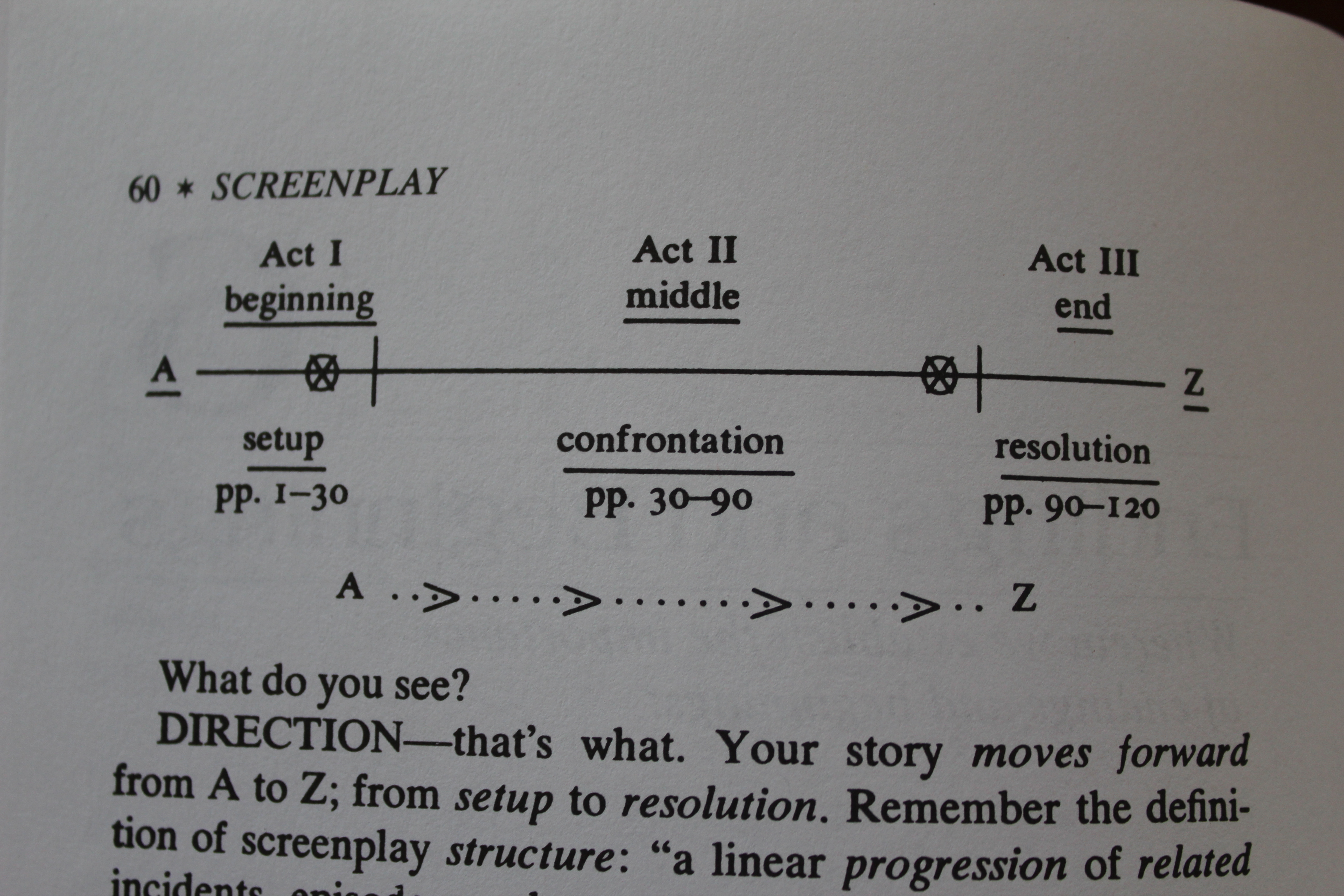
Syd Field wrote many books on screenwriting, but he is best known for Screenplay, first published in 1979 and revised several times since. In Screenplay Field clarifies the basic three-act structure of the modern film–and indeed, of all narrative art. Field did not invent this structure; we find Aristotle beginning to rough it out in his Poetics. But just as Watson and Crick did not invent DNA, but made known its structure, so Field, while not inventing story structure, made it eminently manifest to a contemporary audience.

Act I. An inciting incident upsets the hero’s plans and he is thrown into an adventure. Act II. The attempt to bring the adventure to a halt only results in further complication. Act III. The hero faces the ultimate obstacle to the resolution of his difficulty–an obstacle he either succeeds at overcoming, or fails.

Setup. Confrontation. Resolution.

That’s what a story is.

Field was particularly insistent upon writers knowing the ending of their story: “What is the ending of your story? How is it resolved? Does your main character live or die? Get married or divorced? Get away with the holdup, or get caught? Stay on his feet after 15 rounds with Apollo Creed, or not? What is the ending of your screenplay?” Field believed that the ending is the first thing a writer should know before writing his or her story.

Sound formulaic? Is Field only giving us a recipe for the conventional film with the “Hollywood ending”?

Consider, then, a more highbrow authority, Gilbert Murray (1886-1957), Regius Professor of Greek at Oxford, among other posts. “Most contemporary plays,” writes Murray in The Classical Tradition in Poetry, “admirable in detail and stagecraft as they often are, have weak last acts. Similarly, in the novel…you find a number of writers who can give exquisite studies of character, delicious conversations and individual scenes, but very few who can construct a story with a definite unity of effect and proper climax, or, to use the Greek term, “catastrophe.” One might almost say that they leave that high quality to the writers of detective stories.”

Listen to Professor Murray. The “definite unity of effect and proper climax” is today found most prominently in works of detective and other genre fiction, as well as, we might add, at the movies. Artistes may scoff at three-act structure as the slop of the “masses,” but Murray, notice, refers to it as “that high quality.” It is not a mistake, or in itself a sign of steep cultural decline, that scores of people will flock to their local multiplex this Thanksgiving weekend, rather than hunker down by the fire with Ulysses.

The central reason why three-act structure resonates so profoundly with the human spirit, such that we never tire of its rhythms, is that it allows us, in a most compressed and evident way, to contemplate our lives in miniature. Three-act structure is the structure of life. It is the imitation of ourselves being thrown into an adventure not of our choosing, and of working out a resolution to it in which we ultimately either succeed or fail. Field rightly lays emphasis upon the ending of a screenplay because the whole point of our lives is the ending. Will I realize who I was made to be, or not?

In his work Field gave storytellers not a recipe, but a set of principles applicable in an infinite variety of creative ways, ways as various as the adventures of individual human lives.

Thank you, Syd Field, for your life and work. May you rest in peace.


This article first appeared on Aleteia.

 

Something to Read During Those Long Speeches at the Oscars

When that costume designer you’ve never heard of launches into that interminable Thank You speech, you’ll want something to read to pass the time. But you’re watching the Oscars. You’re in a Hollywood mood. So why not enjoy High Concepts: A Hollywood Nightmare–available here for just $3.99. Below is an excerpt from Chapter 7, “The Deal,” in which my protagonist, a young out-of-work philosophy professor named Donald Wirt, posing as a Hollywood screenwriter, takes a meeting with some bottom-feeding slasher film producers.

Enjoy!

*          *         *

When he had listened to Miles talk to them on the phone, a certain image of Slasher Films had been conjured in Donald’s imagination. A glass office building, its windows reflecting the clouds placidly drifting through the blue Los Angeles sky. A plush suite filled with smartly dressed people busily working the phones and reading scripts.

Slasher Films, in fact, was located in a seedy area of town in a small, one-storey box-structure on pilings that listed precariously. Connoisseurs of all that is most dehumanizing in twentieth-century architecture would recognize in it the death rattle of Bauhaus. Donald found no outward sign that this grim little box on stilts housed a film production company. But the street address matched the one that Miles had given him.

The door was reached by a flight of stairs at the side of the building. Donald’s knock was answered by a tiny, well-presented woman wearing a surgical mask and plastic surgical gloves. Donald staggered backwards as a wave of the woman’s jasmine perfume slammed into his nostrils.

“Hiya, sweetie! What can I do you for?”

“Good afternoon. Are these the offices of Slasher Films?”

“Got it in one! But sorry, hon, the boys don’t take unsolicited pitches.”

“I have an appointment.”

Really? That’s a first. But I’m kind of new here. Come on in. Ima Bumpus.”

“You’re a what?”

“Ha ha. Wish I had a nickel for every time I heard that. My name’s Ima Bumpus. The boys’ executive assistant. Call me Ima. Need a surgical mask? I like to wear one. The air in here can get kind of gamey.”

Donald refused the surgical mask and followed the woman into the house.

“I’ll get one of the boys,” Ima said, and she hurried through the living room picking up discarded pairs of boxer shorts along the way.

Donald waited in a dreary living room with the blinds drawn. Beer cans and bottles were strewn among stacks of books, magazines, videos, DVDs, and scripts. On a rickety coffee table a crusted dinner plate featured the grizzled bits of a gnawed pork chop embedded in a pool of petrified ketchup. An almost suffocating smell, a mixture of curry and burnt microwave popcorn, seemed to ooze from the walls. On one of the walls were posters showcasing the cream of the Blood and Gore oeuvre: The Devil’s Car Wash, Thumbtack Murders, One-Eyed Jack I through IV. Framed stills from these movies tilted at various angles upon the wood paneling, the dominant themes of which were women screaming and a Rogue’s Gallery of grinning killers wielding instruments both blunt and sharp.

After a long delay a large shaggy man in an old t-shirt and sweats, looking as though he had just been roused from sleep, emerged from the bowels of the house. Ima introduced him as “Mr. Brad Blood” before returning to her desk.

“Hello,” Donald extended his hand, “I’m Dr. Donal—I mean, my name is Donnie Wir—uh, Donnie Percival.”

“Sounds like an identity crisis,” Blood drawled as they shook hands.

“My name is Donnie Percival,” Donald colored.

“You from the Labor Commission?”

“Excuse me?”

“Writer’s Guild? Director’s Guild?”

“No. I’m Donnie Percival. The author of Out, Out, Brief Candle!

“How nice for you. Email me a synopsis.”

Blood turned to go.

“We scheduled a meeting for today,” Donald called him back, his voice cracking. “You offered to buy my script. I’m here to sign the contract.”

Blood stopped.

“Not another one,” he sighed and rubbed his tired face with his hand.

There was an uncomfortable silence until the man turned back to Donald and said:

“I gotta get my brother. Wait here.”

“You’re brothers!” Donald smiled, as if he had just gotten the punchline of a very clever joke.

“Yeah,” Blood sneered. “It doesn’t happen often, but sometimes people in Hollywood go by other names, Dr. Donald Donnie Percival.”

As he waited Donald watched Ima Bumpus read from a book called So You Want to Make It in Hollywood.

Blood returned.

“Sorry, dude, but my brother isn’t well enough to meet with you today—”

“Nonsense!” bellowed a voice, and a moment later there emerged, with a wavering step, the spectral presence of Blood’s brother and co-producer.

“Graham Gore!” he announced himself, far more loudly than was strictly necessary, and extended a shaking hand to Donald.

He was a wiry, sun-starved man of thirty, or fifty, dressed casually in a pair of boxer shorts and fuzzy slippers. He had a gaunt, pasty countenance; wisps of soft blonde hair floated like cobwebs above his balding head.

“I’m Donnie Percival,” Donald said boldly. “I’m here to sign the contract for the sale of my script, Out, Out, Brief Candle!

Gore belched and wavered slightly. Blood reached out to steady him.

Out, Out, Brief Candle! Weird title, man. Wassitbout?”

Donald launched into his memorized pitch.

“Uh. There’s this high school teacher, an assistant vice-principal—”

Gore tipped to the right.

“—who with his girlfriend, the advanced Spanish teacher, plots a series of murders as a means of taking over as principal of the school.”

“That’s his external goal,” Gore clarified with a manic smile. “What’s his internal goal?”

Donald hesitated.

Gore tipped to the left.

“Internal goal?”

“His innermost deepest desire,” Gore explained. “Not the thing he wants, but the thing he needs.”

Donald reflected upon this.

“I guess he just wants power and glory.”

Gore beamed at Donald.

“I think we’ll make a writer of you yet—wassyername?”

Pretty Good Writing Advice

When in the midst of a story I need to refocus on the basic principles of narrative structure, I often (perhaps not often enough) go back to what playwright-screenwriter-director David Mamet, in his book on Hollywood, Bambi vs. Godzilla, calls “The Long Lost Secret of the Incas.” The secret consists in three magic questions. “Anyone who wants to know how to write drama must learn to apply these questions to all difficulties,” says Mamet. “It is not only unnecessary but also impossible to know the answers before setting out on the individual project in question, as there are no stock answers.”

Drama, argues Mamet, is a succession of scenes, and a successful scene must “stringently apply and stringently answer the following questions…”

Are you ready?

Here it is. The Long Lost Secret of the Incas.

  1. Who wants what from whom?
  2. What happens if they don’t get it?
  3. Why now?”

That’s it. As a writer, your yetzer ha’ra (evil inclination) will do everything in its vast power to dissaude you from asking these questions of your work. You will tell yourself the questions are irrelevant as the scene is “interesting,” “meaningful,” “revelatory of character,” “deeply felt,” and so on; all of these are synonyms for “it stinks in ice.”

Mamet’s three magic questions are the concentrated version of the famous leaked memo to the writers of his television show, The Unit, available here.

First principles, however, are not the only kind of principles. If Mamet’s three magic questions are the first principles of good storytelling, then Emma Coats’s 22 storytelling principles making their way around the Internet this week articulate some of the most relevant secondary principles. Coats is a storyboard artist at Pixar, a company that knows a thing or two about good storytelling. The following are the maxims she’s gleaned from her years working at the prestigious animation studio:

1: You admire a character for trying more than for their successes.

2: You gotta keep in mind what’s interesting to you as an audience, not what’s fun to do as a writer. They can be v. different.

3: Trying for theme is important, but you won’t see what the story is actually about til you’re at the end of it. Now rewrite.

4: Once upon a time there was ___. Every day, ___. One day ___. Because of that, ___. Because of that, ___. Until finally ___.

5: Simplify. Focus. Combine characters. Hop over detours. You’ll feel like you’re losing valuable stuff but it sets you free.

6: What is your character good at, comfortable with? Throw the polar opposite at them. Challenge them. How do they deal?

7: Come up with your ending before you figure out your middle. Seriously. Endings are hard, get yours working up front.

8: Finish your story, let go even if it’s not perfect. In an ideal world you have both, but move on. Do better next time.

9: When you’re stuck, make a list of what WOULDN’T happen next. Lots of times the material to get you unstuck will show up.

10: Pull apart the stories you like. What you like in them is a part of you; you’ve got to recognize it before you can use it.

11: Putting it on paper lets you start fixing it. If it stays in your head, a perfect idea, you’ll never share it with anyone.

12: Discount the 1st thing that comes to mind. And the 2nd, 3rd, 4th, 5th–get the obvious out of the way. Surprise yourself.

13: Give your characters opinions. Passive/malleable might seem likable to you as you write, but it’s poison to the audience.

14: Why must you tell THIS story? What’s the belief burning within you that your story feeds off of? That’s the heart of it.

15: If you were your character, in this situation, how would you feel? Honesty lends credibility to unbelievable situations.

16: What are the stakes? Give us reason to root for the character. What happens if they don’t succeed? Stack the odds against.

17: No work is ever wasted. If it’s not working, let go and move on–it’ll come back around to be useful later.

18: You have to know yourself: the difference between doing your best & fussing. Story is testing, not refining.

19: Coincidences to get characters into trouble are great; coincidences to get them out of it are cheating.

20: Exercise: take the building blocks of a movie you dislike. How d’you rearrange them into what you DO like?

21: You gotta identify with your situation/characters, can’t just write ‘cool.’ What would make YOU act that way?

22: What’s the essence of your story? Most economical telling of it? If you know that, you can build out from there.

Mamet’s 3 + Coats’s 22. That’s 25 basic storytelling principles that, if followed–as Mamet tells the writers of The Unit–will buy you a house in Bel Air and allow you to hire someone to live there for you.